
Copper vs. Optical Interconnect for AI Clusters: Reach, Power, and Cost Compared
Copper or optical for your AI cluster links? This plain comparison weighs DAC, AEC, and fiber by reach, power, latency, and cost — and sets out the rule operators use to draw the line between them.
On this page
The short answer
Copper interconnect carries electrical signals over twinaxial cable and wins on cost, power, and simplicity at very short distances - typically up to about 2 meters for passive cables at 800G, and 5 to 7 meters for active electrical cables. Optical interconnect converts signals to light and carries them over fiber for tens of meters to kilometers, at higher cost and power per link. AI clusters use both: copper inside the rack, optics between racks.
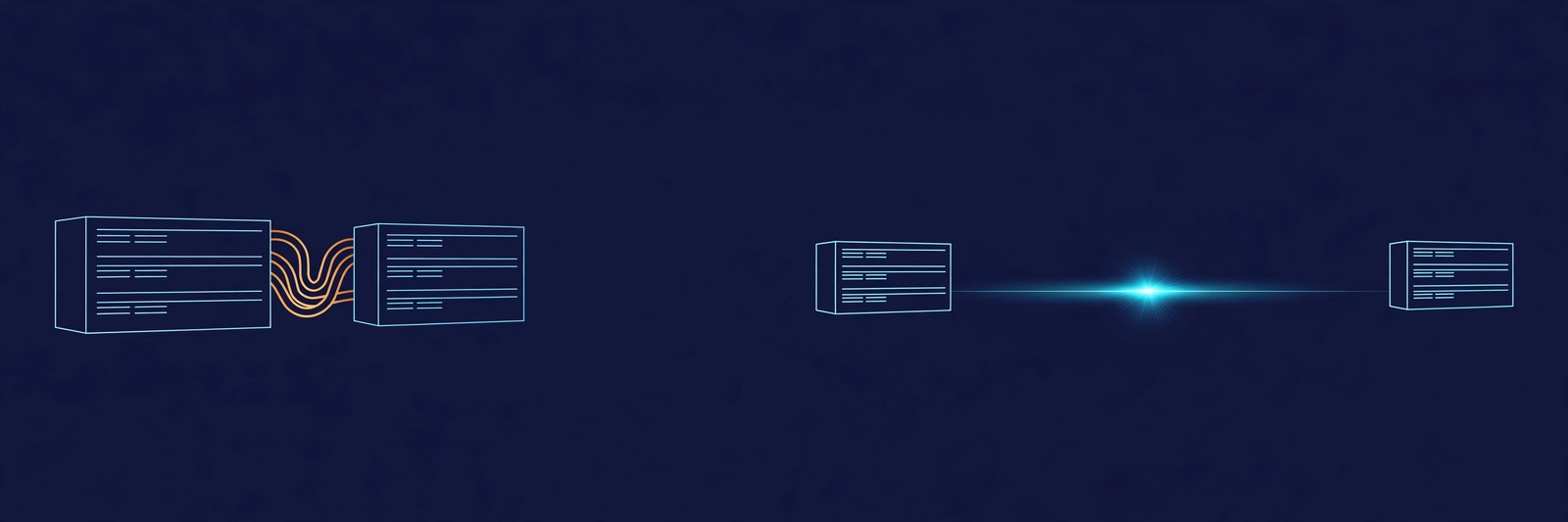
The boundary between the two is set by physics, not preference. The faster an electrical signal runs, the faster it fades in copper: at 100 gigabits per lane, a passive copper cable that worked at 5 meters a generation ago now works at 1 to 2 meters. Light in fiber does not fade that way, which is why every distance beyond a single rack has already gone optical, and why the argument in 2026 is only about where exactly the line sits inside the rack - and how fast it moves toward the chip.
This article compares the three real options - passive DAC, active AEC, and optical modules - on reach, power, latency, and cost, then gives the decision rule operators actually use. It is the second article in our optical interconnect series; the first defined co-packaged optics (CPO), which is what happens when the boundary moves all the way onto the chip package. For week-by-week market context, see our GPU Market Watch; to size the bandwidth your own design needs before choosing links, use the AI cluster bandwidth estimator.
Key facts
- Passive DAC reach at 800G: typically about 1-2 m. Cheapest and lowest-power option; the cable itself consumes no power. (Typical vendor ranges, as of October 2026.)
- AEC reach at 800G: typically about 5-7 m, using retimer or redriver chips in the cable ends; thinner and more flexible than DAC, at a few watts per end.
- Optical reach: standard short-reach optics cover about 500 m (DR-class) to 2 km (FR-class) and beyond - two to three orders of magnitude past copper.
- Scale-up example: NVIDIA's GB200 NVL72 connects 72 GPUs in one rack as a single NVLink domain over copper cabling, with a published aggregate NVLink bandwidth of 130 TB/s and 1.8 TB/s per GPU (NVIDIA product specifications, as of October 2026).
- Power shape: a passive DAC draws effectively 0 W in the cable; an 800G DSP-based optical module typically draws roughly 15-20 W per end. Multiplied by tens of thousands of links, this gap is a facility-level number.
- The trend: each doubling of per-lane signaling rate (100G to 200G lanes) shortens practical copper reach again, moving the copper-optical boundary closer to the chip every generation.
- What does not differ much: propagation latency per meter. Both signals travel at roughly two-thirds of light speed in their medium; electronics, not the medium, dominate link latency.
The three options, in plain terms
Direct attach copper (DAC) is a twinaxial copper cable with connector cages at both ends and nothing in between - no chips, no conversion. The switch or GPU SerDes drives the cable directly. It is the cheapest link in the building, draws no power of its own, and is exactly as inflexible as a thick copper cable sounds: stiff, heavy in bundles, and limited to very short runs at modern speeds.
Active electrical cable (AEC) keeps the copper but puts small signal-conditioning chips - retimers or redrivers - inside the connectors at each end. The chips clean up the signal, which buys back reach (about 5-7 m at 800G) and lets the cable itself be much thinner and more bendable than a passive DAC of the same length. The price is a few watts per end and a cable that costs more than DAC, though still far less than optics at the same speed.
Optical modules convert the signal to light in a pluggable transceiver (or, in newer designs, a linear-drive or co-packaged engine) and send it over fiber. Conversion costs money and power at both ends, and in exchange distance stops mattering at data-center scale: the same 800G that fades in 2 meters of copper runs 500 meters in fiber without repeaters. Fiber is also thin, light, and indifferent to the cable-bend and airflow problems of copper bundles.
Reach: the deciding constraint
Almost every copper-versus-optical decision is made by reach, because reach is the one variable you cannot engineer around. An electrical signal in copper loses energy and smears as it travels, and the loss grows sharply with frequency. An 800G link is eight 100G lanes; a 1.6T link is eight 200G lanes. Each step doubles the frequency the copper must carry, and practical passive reach roughly halves: cables that reached 3 meters at 400G reach about 1 to 2 meters at 800G, and less at 1.6T.
That arithmetic explains the standard AI factory layout. Inside a rack, a GPU sits within roughly 1 to 3 meters of the top-of-rack switch or of its scale-up neighbors - copper territory, especially with AEC for the longer runs. Between racks, distances jump to 10, 30, or 100 meters - optical territory, no debate. Across a campus or between buildings, only optics exist. Nobody at scale chooses copper for a 30-meter run because it is cheaper per cable; it simply does not carry the signal.
The interesting fight is inside the rack, and it is why scale-up domains are the exception that proves the rule. NVIDIA's GB200 NVL72 keeps 72 GPUs in one NVLink domain by cabling them in copper inside the rack - a design that works precisely because the rack keeps every run inside copper's shrinking comfort zone, and because skipping roughly two transceivers per link, across thousands of links, removes a large block of cost and power. The same physics is also why that trick does not extend to 144 GPUs across two racks: the boundary is meters, and it does not negotiate.
Power and heat
Copper's second advantage is power. A passive DAC consumes nothing in the cable; the cost is paid in the SerDes on the chips at each end, which must drive harder as the cable lengthens. An AEC adds a few watts per end for its retimers. A DSP-based 800G optical module typically draws roughly 15 to 20 watts per module - two modules per link - before counting the laser and the cooling for all of it.
Scale makes this decisive at short reach. A fabric with 10,000 short links implemented in optics instead of copper can spend on the order of hundreds of kilowatts extra, continuously, on conversion alone - power that also has to be cooled. This is the same picojoule-per-bit arithmetic from our CPO guide, one step earlier: copper wins the power contest exactly where it can reach, and loses the moment it cannot. AECs and linear-drive optics (LPO) exist to narrow the gap from opposite sides - AEC by stretching copper's reach, LPO by stripping the DSP out of the module.
Cost, honestly framed
Per link, the ordering is stable: DAC cheapest, AEC in the middle, optics most expensive - an 800G optical link costs several times its copper equivalent once both modules and fiber are counted, with exact prices moving fast enough that any fixed dollar figure printed here would be stale on arrival. But per-link price is not the whole ledger, and honest comparisons count three more things.
- Cabling labor and airflow. Thousands of stiff DACs are heavy, block airflow, and slow down installation and service. Thin AEC and fiber runs install faster and cool easier - a real, if unglamorous, offset to copper's sticker price.
- Failure and service. Copper cables fail rarely and swap in seconds. Optical modules are the more failure-prone and more frequently replaced component, and they add a sparing inventory copper does not need.
- Reach mistakes. The most expensive option is the wrong one: speccing copper past its reach buys link errors and retraining runs; speccing optics inside a rack buys thousands of needless transceivers. Both errors are common in first-draft cluster BOMs.
Common mistakes
- Assuming last generation's reach. A cable plant designed around 400G copper reach silently breaks at 800G. Check reach at the lane rate you will actually run, not the one in the old design.
- Comparing cable price instead of link cost. An optical link is two modules plus fiber plus power plus cooling; a copper link is a cable plus SerDes drive power. Compare totals per working link.
- Ignoring the scale-up / scale-out split. Scale-up links (inside the NVLink domain) and scale-out links (the Ethernet or InfiniBand fabric) have different distance and bandwidth shapes. Sizing both with one technology is how budgets leak - estimate each separately with the AI cluster bandwidth estimator.
- Forgetting bend radius and airflow. Dense DAC bundles in a hot aisle are a cooling problem disguised as a cabling choice. AEC's thinner cable often pays for itself here alone.
The decision rule
- Up to about 2 m at 800G: passive DAC, unless cable bulk or airflow argues for AEC.
- About 2-7 m: AEC - the in-rack and rack-to-adjacent-rack band.
- Beyond about 7 m, or any run between rows or rooms: optical, with the module class (DR, FR, or longer) matched to the actual distance - see our guide to 800G and 1.6T optical modules.
- Designing the next generation, not this one: assume copper's band shrinks again at 200G lanes, and keep an eye on CPO, which removes the boundary dispute by converting to light on the package.
That is the whole framework: copper where it reaches, optics where it does not, and a boundary that physics moves a little closer to the chip every generation. The rest of this series follows the optical side of the line - starting with the 800G and 1.6T modules themselves - and tracks the market side weekly in the GPU Market Watch.
Frequently asked questions
Is copper or optical better for AI clusters?
Neither is better in general - they win at different distances. Inside a rack, where links are one to three meters, copper (DAC or AEC) is cheaper, lower-power, and simpler. Between racks and across a data hall, only optical fiber carries 400G, 800G, and 1.6T signals the required distance. Large AI fabrics use both: copper within the rack or scale-up domain, optics for scale-out.
How far can an 800G copper cable reach?
A passive 800G DAC is typically usable for about 1 to 2 meters. An active electrical cable (AEC), which adds signal-conditioning chips at each end, typically reaches about 5 to 7 meters. Beyond that, attenuation at 100G and 200G per lane makes copper impractical and the link moves to optical fiber. Figures are typical vendor ranges as of October 2026, not guarantees for a specific cable.
Why does the NVIDIA GB200 NVL72 use copper inside the rack?
Because within one rack the distances are short enough for copper to work, and at 72 GPUs the savings multiply. NVIDIA's published NVL72 design connects its 72 GPUs into one NVLink domain using copper cabling inside the rack, avoiding thousands of optical transceivers - and their power draw and cost - for links that never leave the rack. Links between racks still use optical Ethernet or InfiniBand.
Does optical add latency compared with copper?
Very little, and usually not the part that matters. Light in fiber and electricity in copper both travel at roughly two-thirds the speed of light in vacuum, so per meter the difference is negligible. The real latency difference sits in the electronics: a DSP-based optical module adds signal-processing delay that a passive DAC does not have, while retimed AECs sit in between. For training fabrics, switch and protocol latency normally dominate either way.
When will copper stop being used in AI clusters?
Copper is not disappearing; its territory is shrinking as lane rates rise. Each doubling of per-lane speed roughly halves copper's practical reach, so every new generation pushes the copper-to-optical boundary closer to the chip - first between racks, then within racks, and eventually, with co-packaged optics, to the package itself. Expect copper to keep the shortest links (inside servers and single racks) for years while optics take everything longer.